| Duration: 12 day | Max Altitude: 5100m | ||
| Group Size: 2-10 | Location: manaslu | ||
| Difficulty: moderate | Per Day Walk: 06-07 hrs | ||
| Accommodation: Hotel/teahouse |
Manaslu Circuit Trek
Standing in the shadow of the “Mountain of the Spirit,” you’ll feel what few trekkers in Nepal experience anymore—genuine solitude. As you follow ancient salt-trading routes along the Budi Gandaki River, each step on the Manaslu Circuit Trek reveals landscapes unspoiled by mass tourism. Unlike Eversest Base Camp Trek and Annapurna Circuit Trek that are crowded, this hidden gem offers authentic encounters with traditional Tibetan-influenced villages, breathtaking mountain panoramas, and the exhilarating challenge of crossing the 5,160m Larkya La Pass.
The Manaslu trek isn’t just a hike—it’s a journey through five distinct climate zones, from subtropical jungles to alpine meadows, where you’ll witness the dramatic transition from Hindu villages to Tibetan Buddhist communities. With every ridge crossed and valley traversed, the majestic 8,163m Mount Manaslu—the world’s eighth-highest peak—reveals different facets of its towering presence.
For adventure seekers craving both physical challenge and cultural immersion, the Manaslu Circuit delivers Nepal’s last truly authentic circuit trekking experience.
Manaslu Circuit Trek Summary
| Trek Detail | Information |
| Region | Manaslu Conservation Area, Nepal |
| Duration | 12 days |
| Group Size | 2-10 trekkers |
| Difficulty | Moderate |
| Accommodation | Hotels in Kathmandu, teahouses during trek |
| Maximum Altitude | 5,160m at Larkya La Pass |
| Daily Walking | 6-7 hours |
| Best Time to Trek | March-May, September-November |
| Starting Point | Soti Khola (700m) |
| Ending Point | Tal (1,700m) |
| Meals | Three daily meals included |
| Cost | $1,575 USD per person |
Major Highlights of the Manaslu Trek
The Manaslu Circuit offers experiences that even veteran Himalayan trekkers describe as transformative:
- Face-to-face encounters with Mt. Manaslu (8,163m) – Wake to unobstructed views of the mountain’s imposing north face from Sama Gaon village, where the massive glacier-draped summit dominates the skyline
- Cultural immersion in authentic Tibetan Buddhist villages – Explore ancient monasteries in Lho and Sama Gaon, where prayer flags flutter and daily rituals remain unchanged for centuries
- Crossing the legendary Larkya La Pass (5,160m) – Experience the trek’s crowning achievement as you traverse this high mountain pass at dawn, rewarded with 360° panoramas of Himlung (7,126m), Kang Guru (6,981m), and Annapurna II (7,937m)
- Biodiversity from subtropical jungles to alpine meadows – Witness dramatic ecological transitions as you trek through dense forests teeming with monkeys, cross terraced fields, and ascend to stark high-altitude landscapes
- Remote hot springs at Tatopani – Soothe trail-weary muscles in natural hot springs while gazing at snow-capped peaks
- Manaslu Base Camp side trip – For the adventurous, this optional acclimatization day excursion brings you to the foot of the mountain, where climbers begin their ascent
- Stone-paved trails through traditional Gurung villages – Walk the same paths that locals have used for centuries, connecting villages where life moves at a different pace
- Opportunities to spot Himalayan wildlife – Keep your eyes open for blue sheep, musk deer, and if you’re extremely fortunate, the elusive snow leopard
The Manaslu Circuit’s remoteness has preserved both its natural beauty and cultural authenticity in ways that Nepal’s more famous trekking routes lost decades ago.
Includes
- Airport pickup and drop-off in Kathmandu
- Licensed local guide (all our guides are experienced with the Manaslu region)
- Porter service (1 porter for every 2 trekkers, carrying up to 9kg per person)
- All transportation (Kathmandu to Soti Khola and Tal to Kathmandu)
- Shared accommodation during the trek (teahouses/lodges)
- Three meals daily during the trek (breakfast, lunch, dinner)
- All necessary permits (Restricted Area Permit, TIMS, MCAP, ACAP)
- First aid kit with guide
- Pre-departure information briefing
- All Nepal government taxes
- Farewell dinner in Kathmandu
- Mountain Routes t-shirt souvenir
Excludes
- Airfare to/from Nepal
- Nepal visa fees (available on arrival: $30 for 15 days, $50 for 30 days)
- Travel and rescue insurance (mandatory)
- Personal expenses (laundry, phone calls, snacks)
- Wi-Fi and hot showers during the trek (available at additional cost)
- Personal trekking equipment
- Tips for guides and porters (recommended: $5-10 per day for guides, $3-5 per day for porters)
Trekking the Manaslu Circuit: Itinerary, Must-See Highlights & What to Expect
Manaslu Circuit Trek Itinerary: 12 Days
-
Day 1:
Drive from Kathmandu (1,350 m) to Machha Khola (870 m) via Arughat
-
Day 2:
Trek Machha Khola to Jagat (1,340 m)
-
Day 3:
Trek Jagat to Deng (1,860 m)
-
Day 4:
Trek Deng to Namrung (2,630 m)
-
Day 5:
Trek Namrung to Lho (3,180 m) or Shyala (3,500 m)
-
Day 6:
Trek Shyala to Samagaun (3,530 m)
-
Day 7:
Rest and acclimatization day in Samagaun (3,530 m)
-
Day 8:
Trek Samagaun to Samdo (3,860 m)
-
Day 9:
Trek Samdo to Dharmashala (4,460 m)
-
Day 10:
Cross Larke La Pass (5,160 m) and trek to Bhimthang (3,720 m)
-
Day 11:
Trek Bhimthang to Goa (2,510 m) or Tilche (2,300 m)
-
Day 12:
Drive Tilche to Besisahar (760 m) and continue to Kathmandu
-
Day 1 : Drive from Kathmandu to Machha Khola via Arughat (870 m, 8–9 hrs)
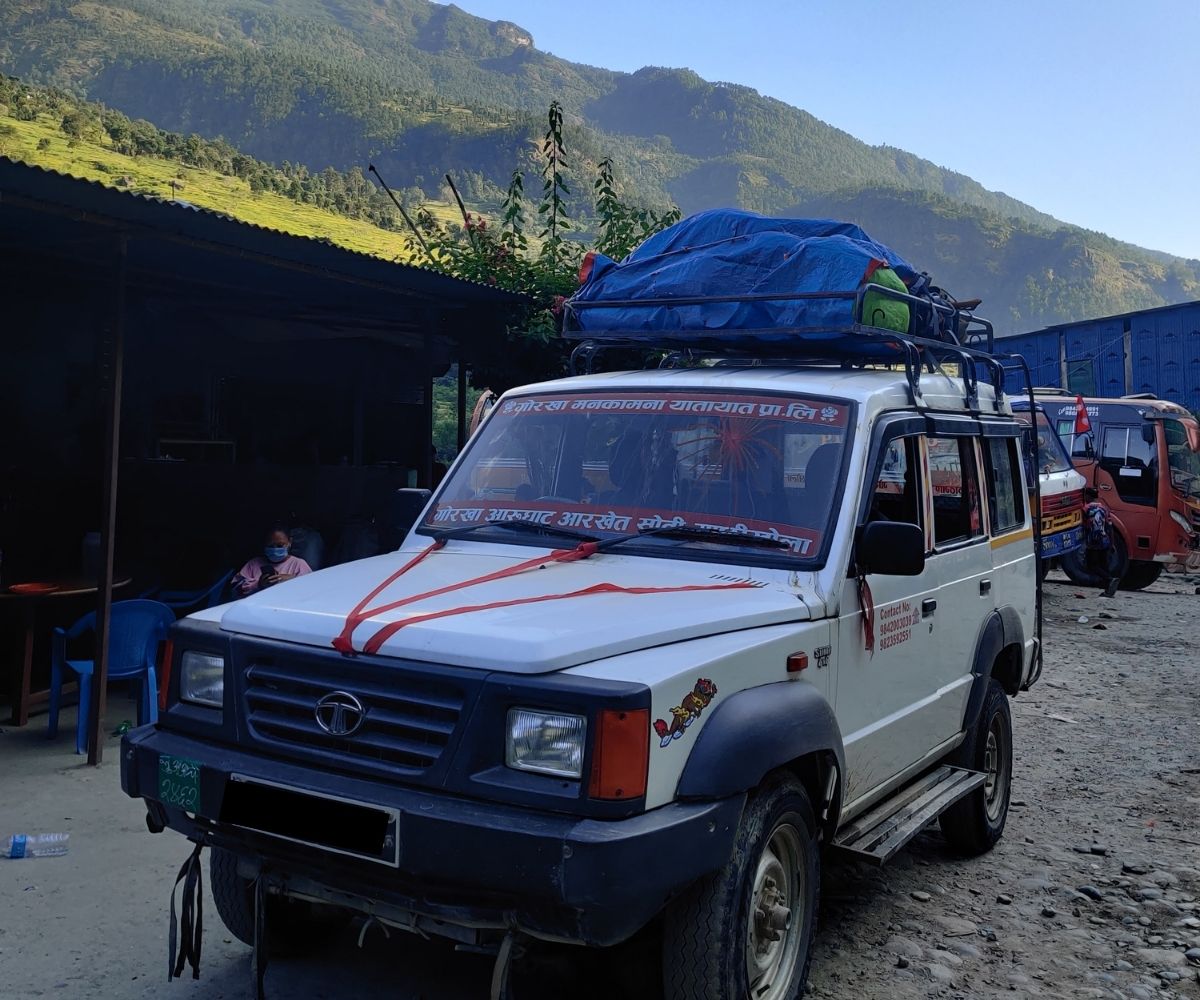
Driving from Kathmandu to Machha Khola via Arughat on a mountain road Your journey begins with a long drive from Kathmandu. The road passes through Arughat and winds along rivers, green hills, and small villages. By evening, you’ll reach Machha Khola, a small riverside town and the starting point of the Manaslu trek.
-
Day 2 : Trek from Machha Khola to Jagat (1,340 m, 6–7 hrs) (1,340 m, 6–7 hrs)
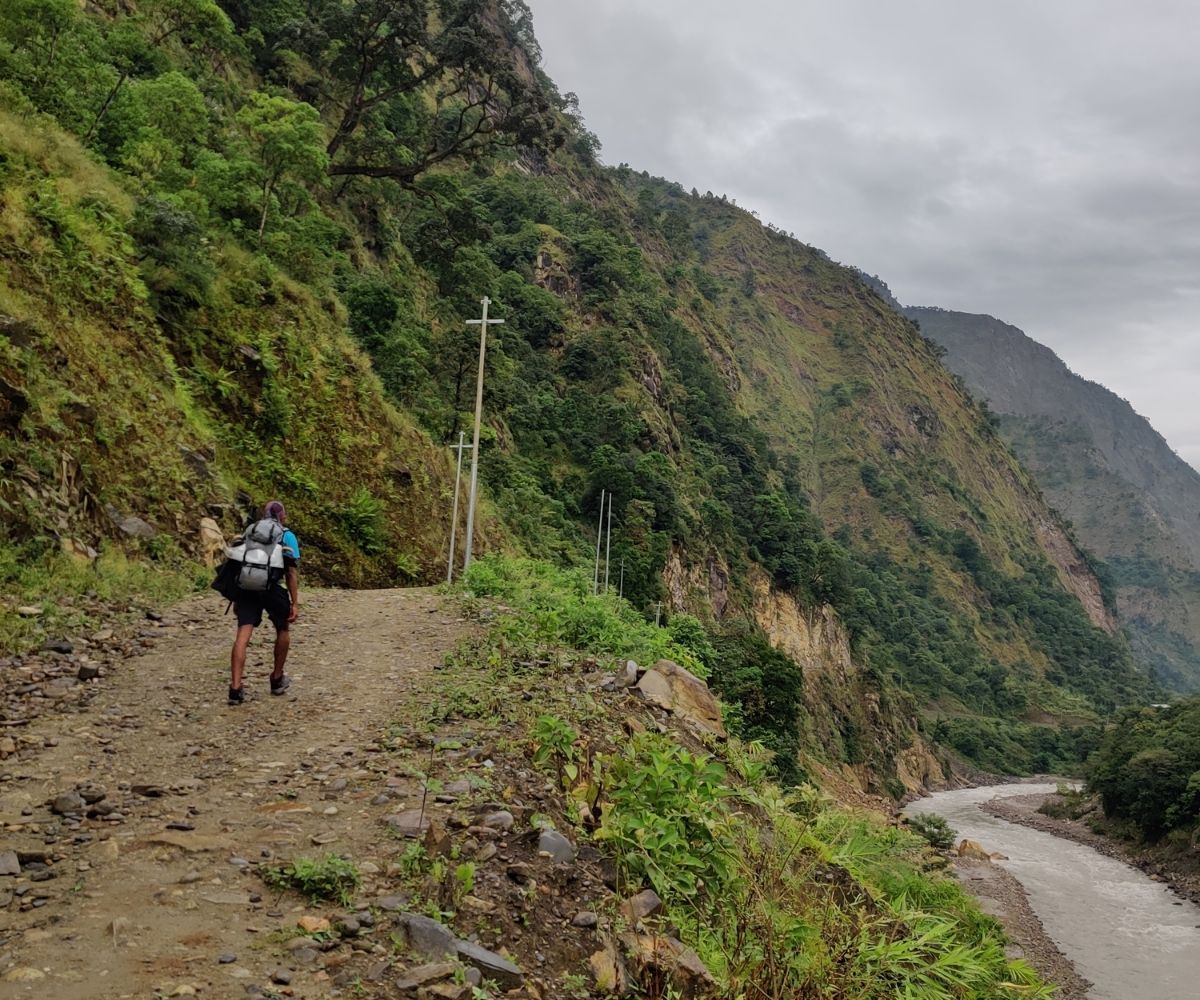
Hiking from Machha Khola to Jagat along a rocky trail This day is all about following the Budhi Gandaki River. The trail goes through small Gurung villages, suspension bridges, and forested paths. Jagat is a traditional stone-paved village and the official entry point of the Manaslu Conservation Area.
-
Day 3 : Trek from Jagat to Deng (1,860 m, 6–7 hrs)
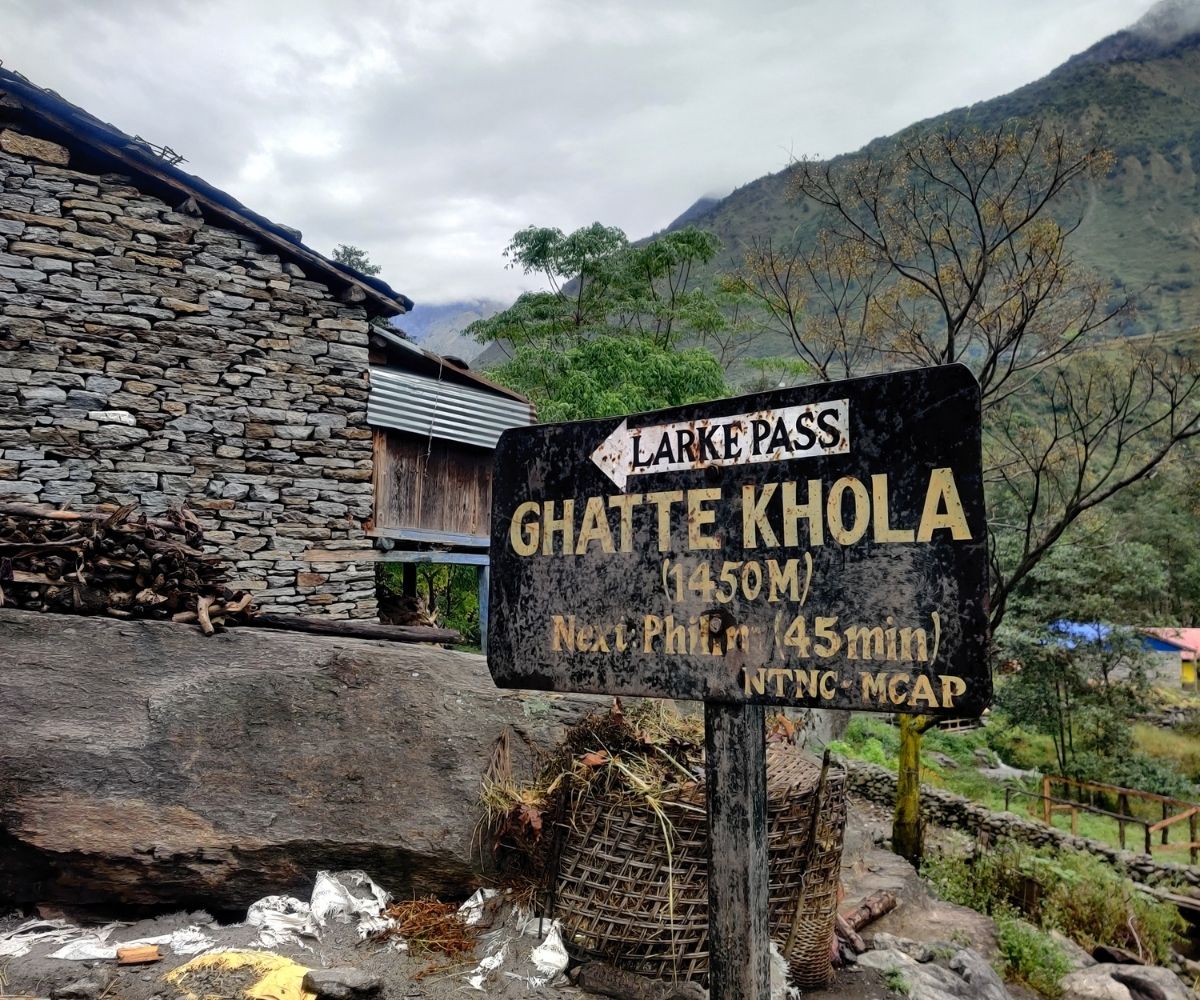
Passing Ghatte Khola on the way to Philim, a scenic stop on Day 3 from Jagat to Deng The Manaslu trekking route climbs gradually with waterfalls and terraced fields along the way. You’ll pass through Salleri and Sirdibas before reaching Deng, a small village surrounded by cliffs. The views of Shringi Himal begin to open up here.
-
Day 4 : Trek from Deng to Namrung (2,630 m, 6–7 hrs)
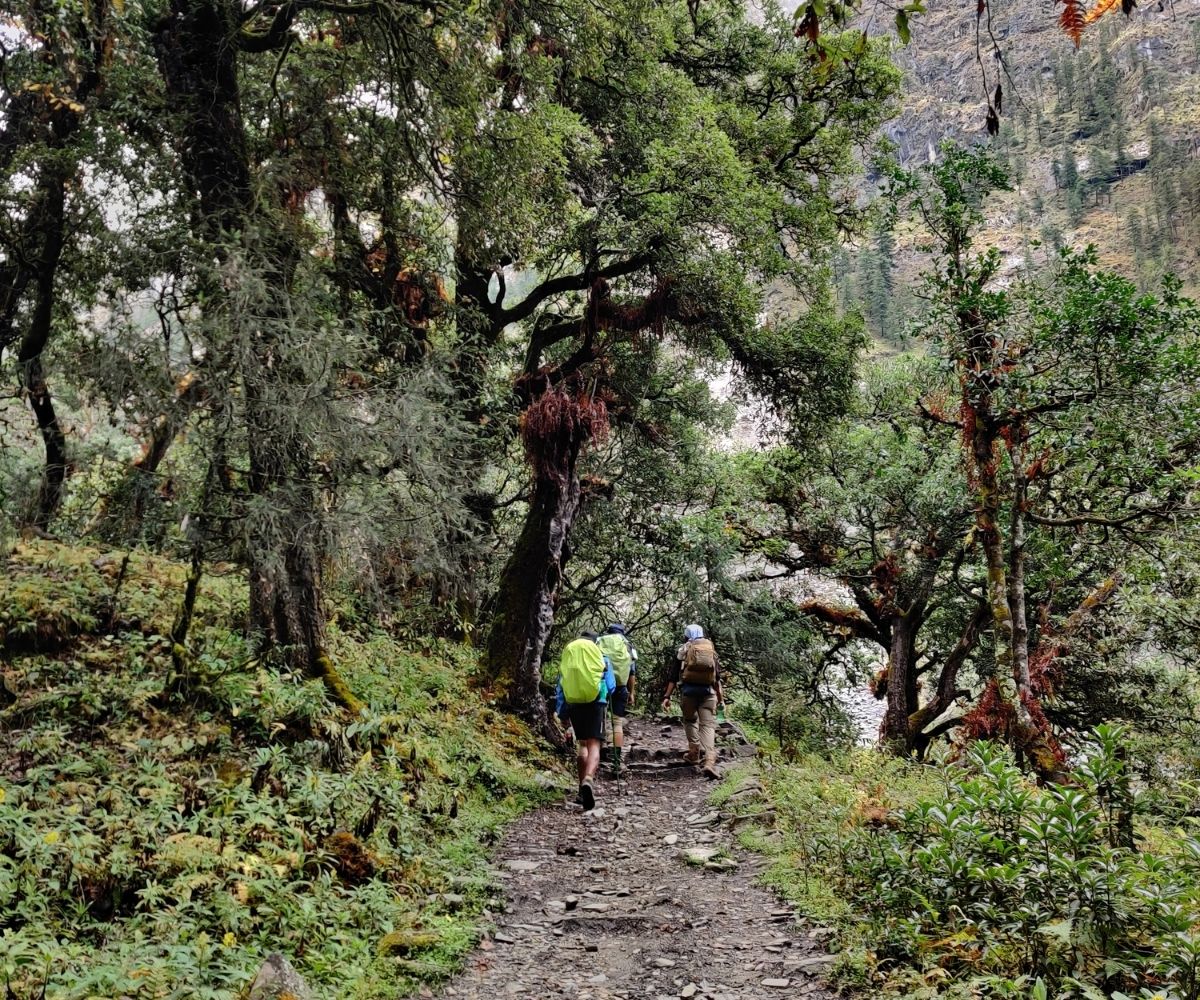
Walking through lush forest trails from Jagat to Deng on the Manaslu Circuit The trail enters more alpine landscapes with rhododendron and pine forests. As you trek toward Namrung, you’ll see prayer flags, mani walls, and chortens. Namrung is a great spot to watch sunrise over Manaslu and Ganesh Himal.
-
Day 5 : Trek from Namrung to Lho (3,180 m) or Shyala (3,500 m, 5–6 hrs)
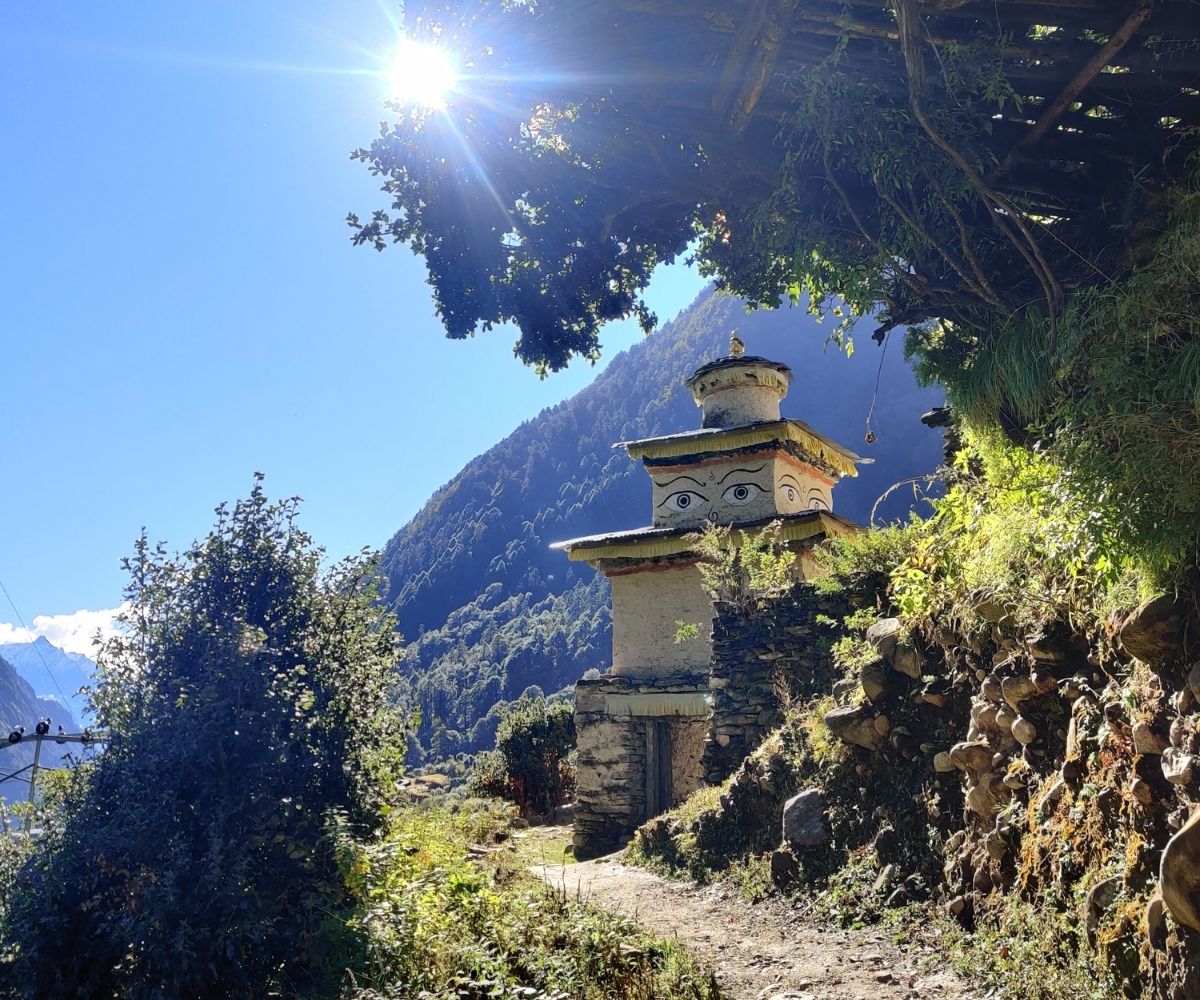
Stupa with Buddha eyes on the Manaslu Circuit trail near Namrung, Nepal This part of the Manaslu Circuit trek is rich in Tibetan culture. You’ll pass Lihi and Sho villages before deciding to stay at Lho or Shyala. Lho is known for Ribung Monastery, while Shyala offers stunning views of Himal Chuli, Peak 29, and Manaslu.
-
Day 6 : Trek from Shyala to Samagaun (3,530 m, 4–5 hrs)
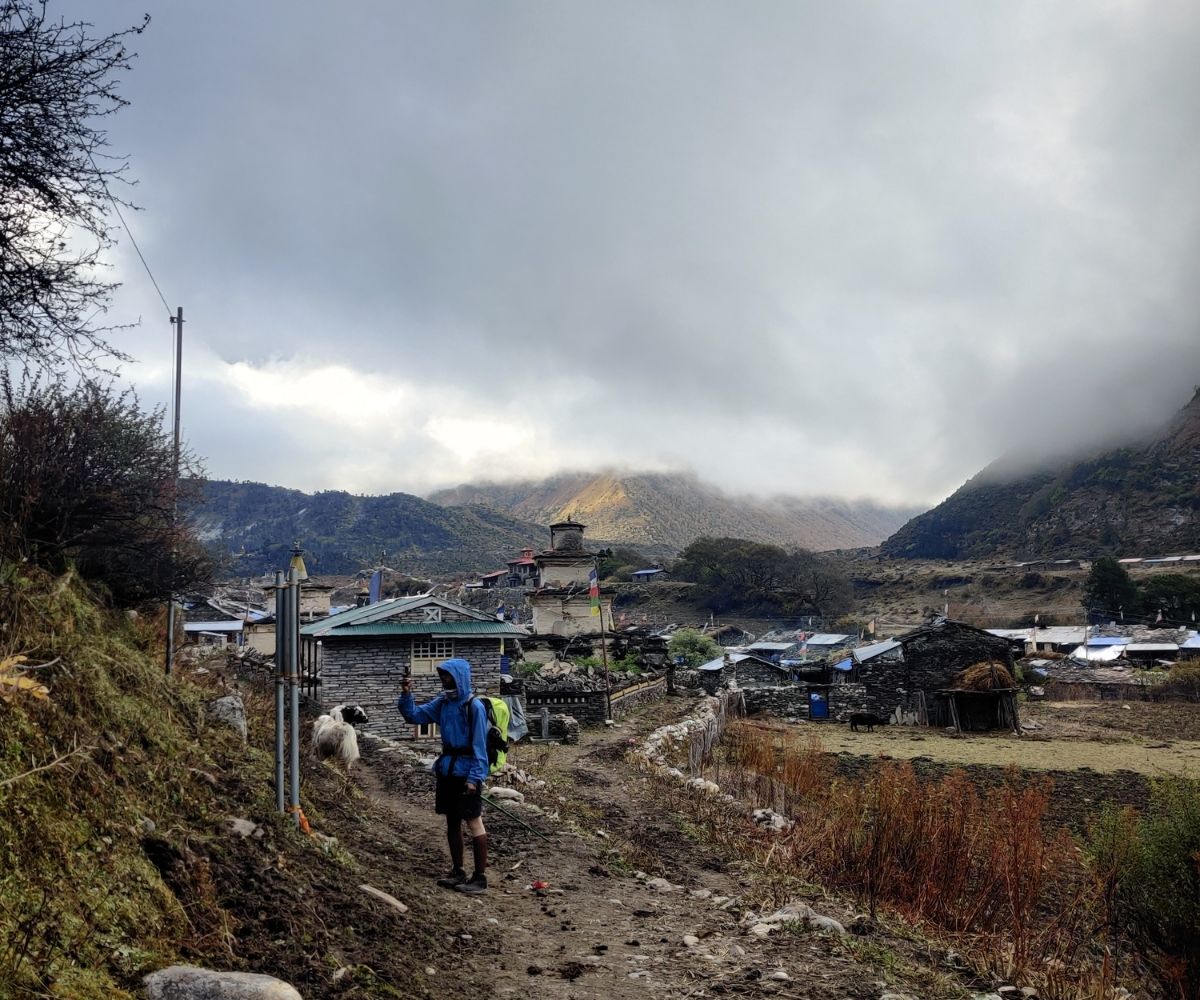
Day 6 of manaslu trek where trekkers enjoy the route from Shyala to Samagaun The walk is shorter and easier today. The valley opens up as you move closer to Manaslu. Samagaun is one of the biggest villages on this trail and a perfect place to see traditional Tibetan lifestyle. From here, you can spot Mount Manaslu up close.
-
Day 7 : Rest and Acclimatization in Samagaun (3,530 m) Trip Duration: 04 hrs
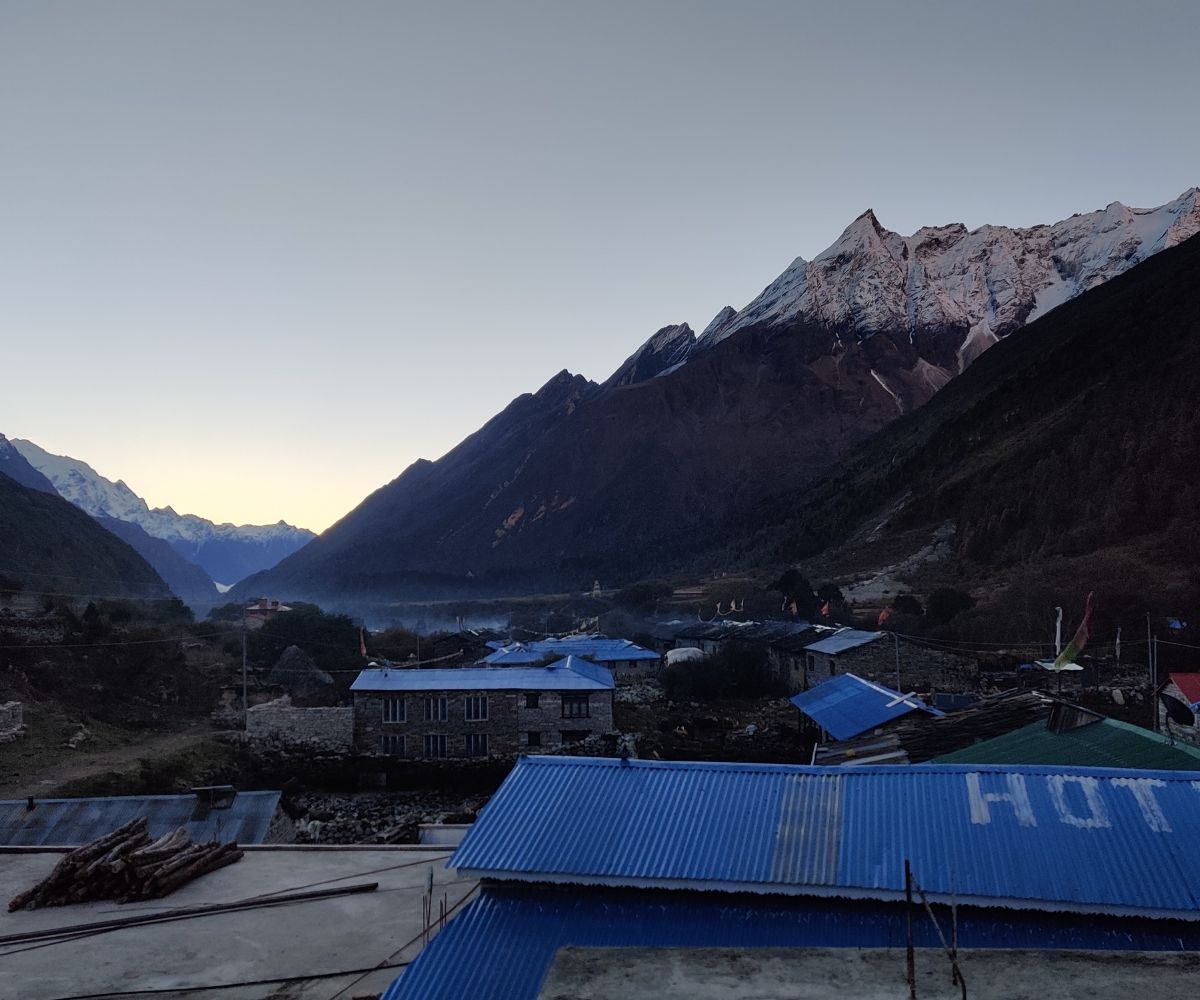
Morning view of Samagaun during rest and acclimatization day on the Manaslu Circuit Take it easy today and let your body adjust to the altitude. You can explore nearby side hikes like Manaslu Base Camp, Pungyen Gompa, or Birendra Lake. This acclimatization day is key for preparing your body for Larke La Pass.
-
Day 8 : Trek from Samagaun to Samdo (3,860 m, 3–4 hrs) (3,860 m, 3–4 hrs)
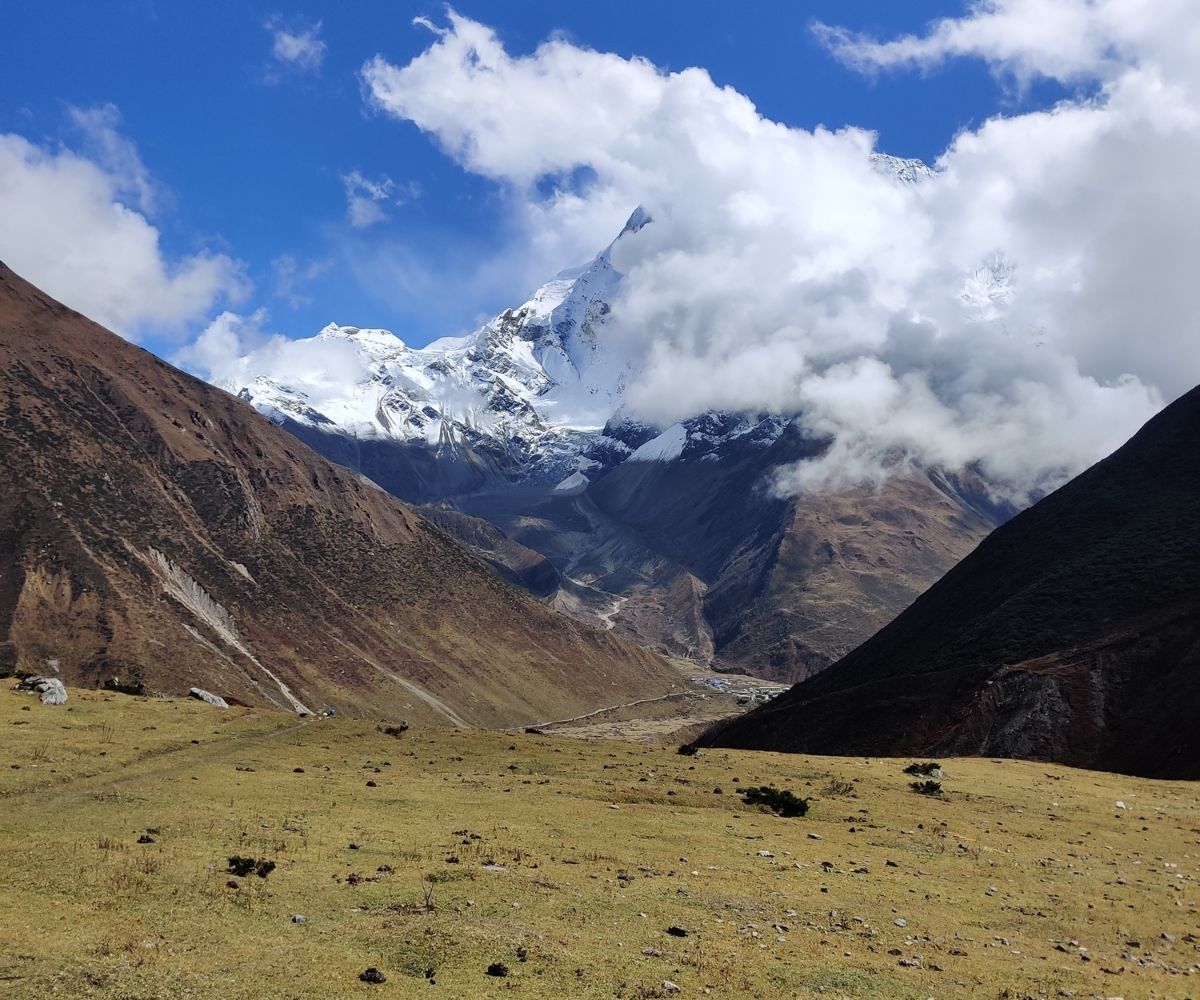
Trail from Samagaun to Samdo with mountain landscapes The trail to Samdo is short but scenic. You’ll walk along yak pastures and cross wooden bridges. Samdo is a Tibetan refugee village near the border with Tibet. From here, you’ll notice the landscape becoming more rugged and alpine.
-
Day 9 : Trek from Samdo to Dharmashala (4,460 m, 4–5 hrs)
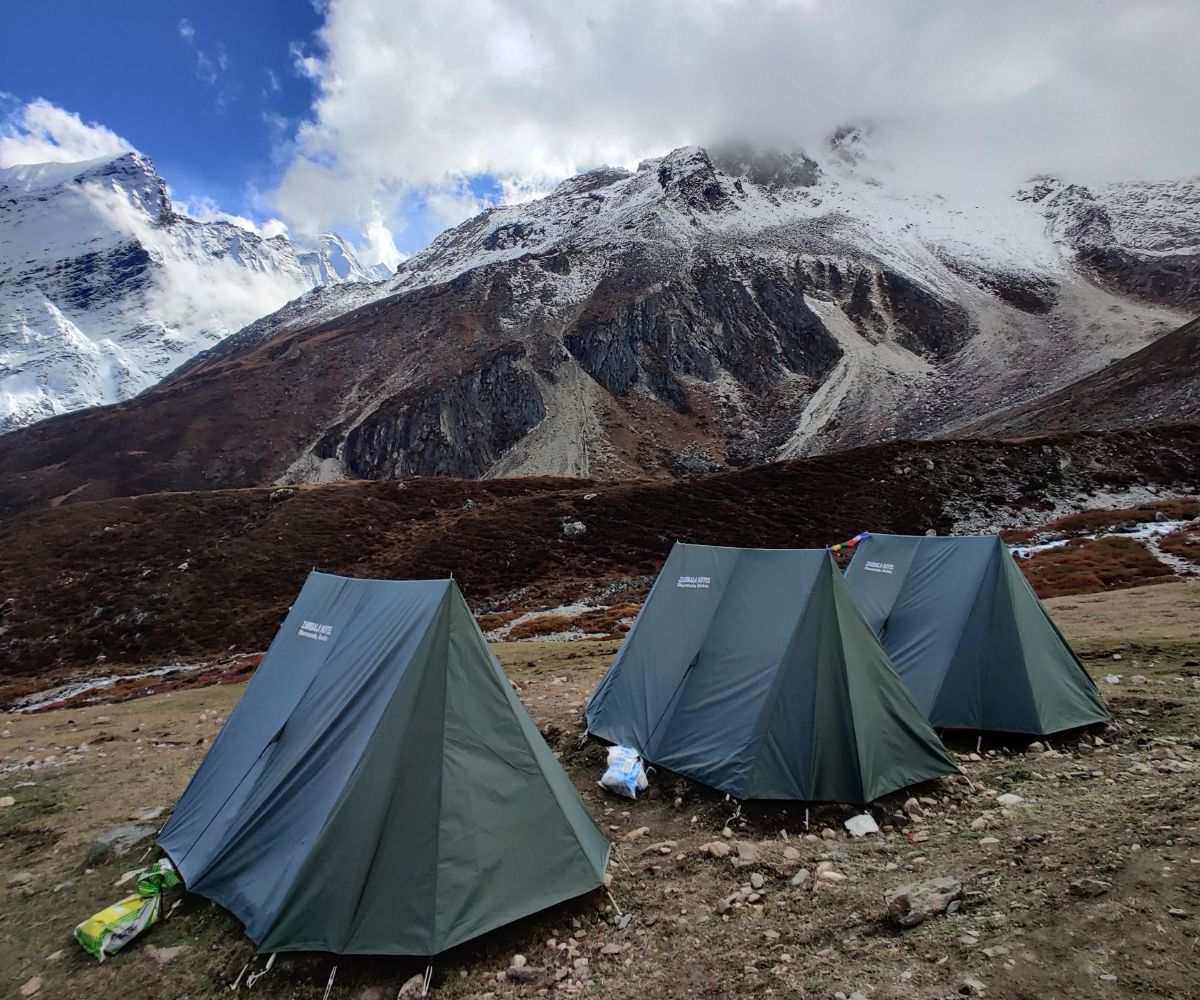
Dharmashala the final stop before crossing Larke Pass The route climbs steadily toward Dharmashala, also called Larke Phedi. This is the last stop before crossing Larke La Pass. The area has basic lodges and offers wide views of snow-capped peaks. Rest well here because tomorrow is the toughest day.
-
Day 10 : Cross Larke La Pass (5,160 m) and Trek to Bhimthang (3,720 m, 8–9 hrs)
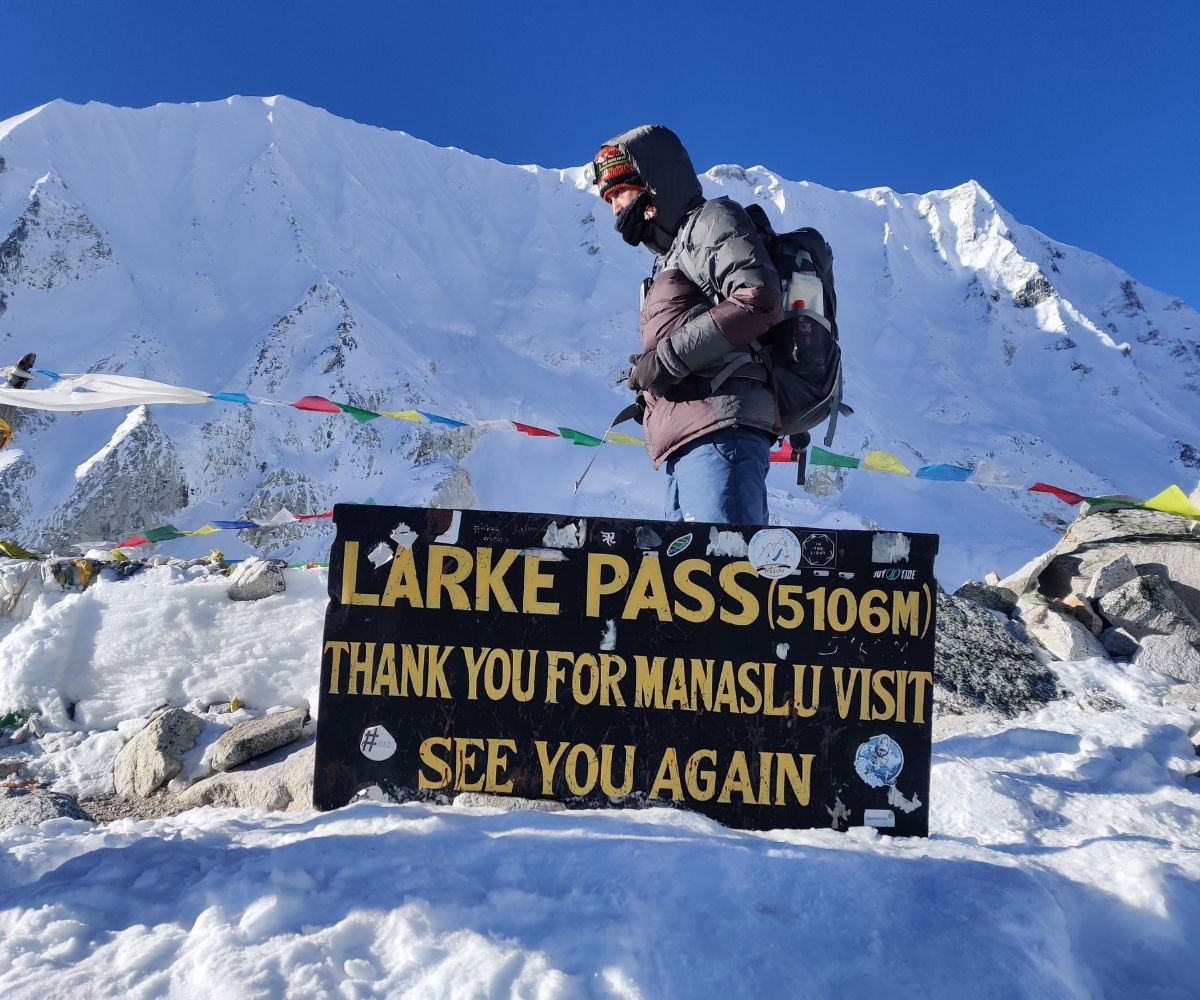
Trekkers reach the snowy high point of Larke Pass at 5,106 m This is the highlight of the Manaslu Circuit trek. The climb to Larke La Pass is steep and challenging, but the reward is breathtaking. From the top, you’ll see Annapurna II, Himlung Himal, Cheo Himal, and Kang Guru. The descent to Bhimthang is long but beautiful with glacier views and alpine valleys.
-
Day 11 : Trek from Bhimthang to Goa (2,510 m) or Tilche (2,300 m, 5–6 hrs)
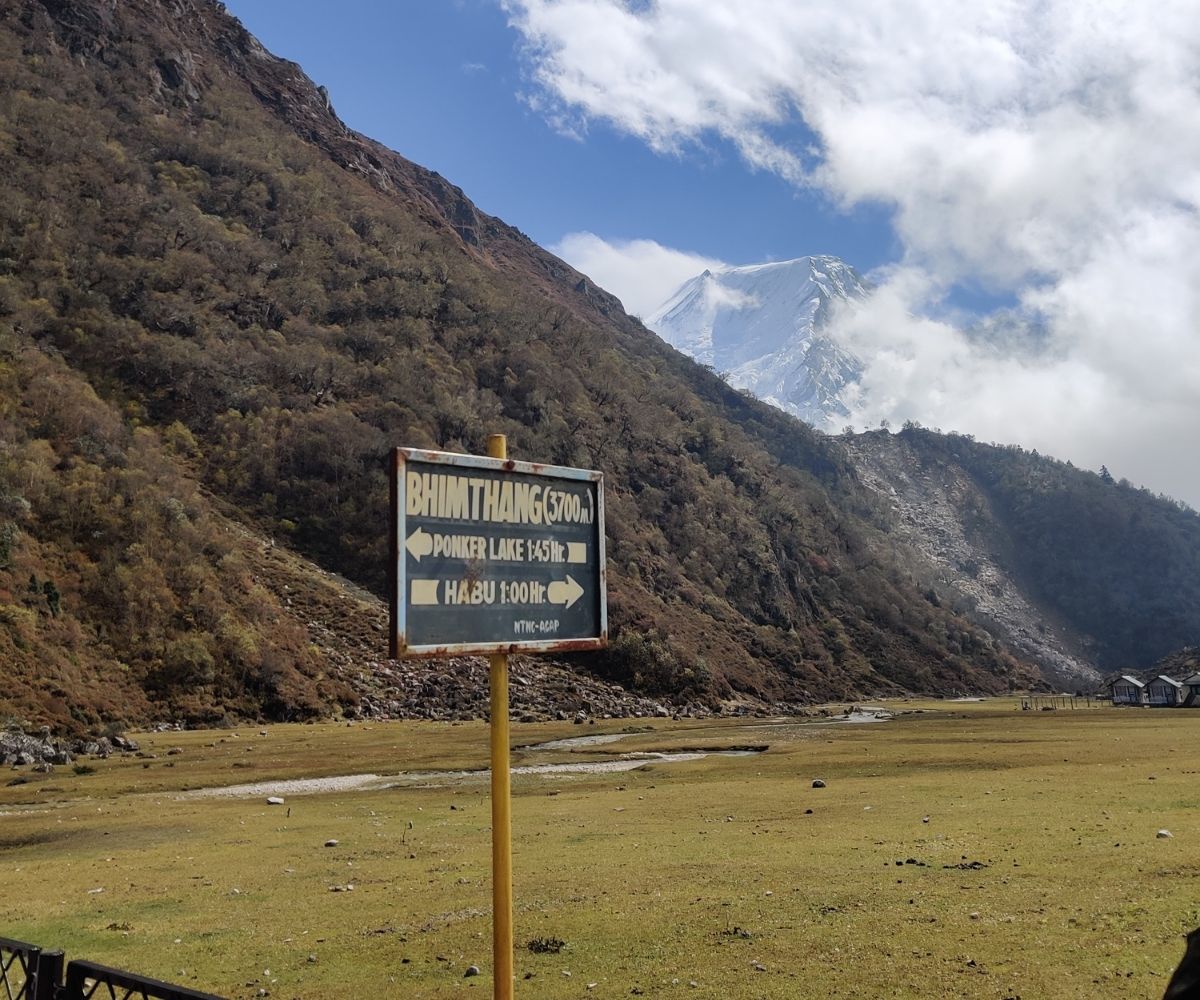
Day at Bhimtang (3,700 m) with signpost pointing to Ponker Lake and Habu The trail drops through pine and rhododendron forests. You’ll cross rivers and small settlements before reaching Goa or Tilche. The air feels warmer and you’ll notice more greenery compared to the high passes.
-
Day 12 : Drive from Tilche to Besisahar (760 m) and Return to Kathmandu Trip Duration: 04 hrs
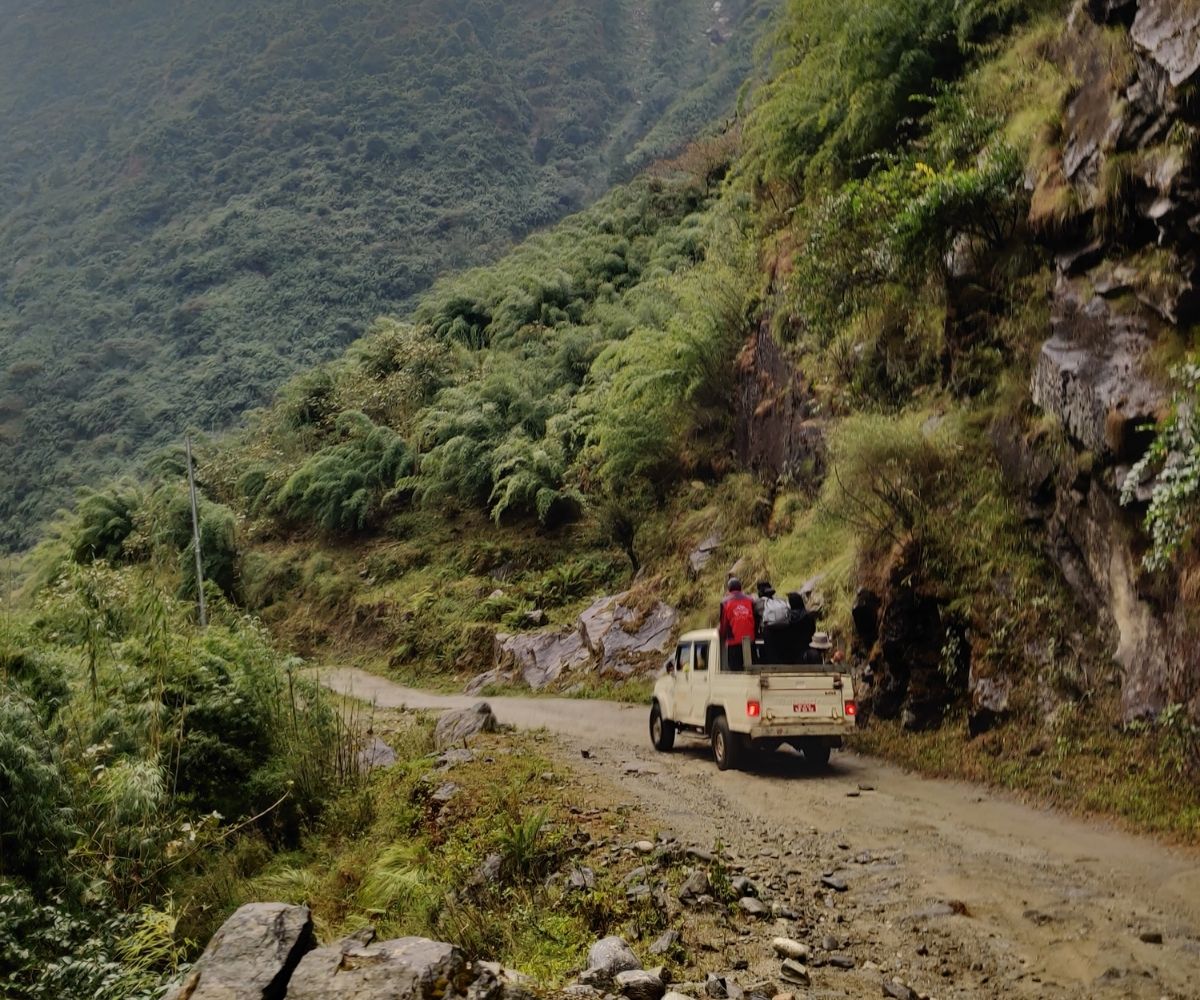
Drive from Tilche down the winding roads to Besisahar The trek ends with a jeep ride from Tilche to Besisahar. From there, you continue the drive back to Kathmandu. The journey feels long but relaxing, giving you time to reflect on your trek around Manaslu.
Manaslu Circuit Trek Map & Route
The Manaslu Circuit creates a horseshoe-shaped path around Mount Manaslu, starting in the subtropical lowlands and climbing counterclockwise to cross the Larkya La Pass before descending into the Annapurna region.
Starting Point: Your journey begins at Soti Khola (700m), accessible by jeep from Kathmandu.
The Route Path:
- Lower Valley Section: Following the Budhi Gandaki River through terraced fields and subtropical forests, you’ll trek through villages including Machha Khola, Jagat, and Pewa
- Middle Mountain Section: As you climb through Namrung, Lho, and into Sama Gaon, you’ll transition into pine forests and Tibetan Buddhist villages where the cultural landscape shifts dramatically
- High Alpine Section: The trek from Sama Gaon through Samdo to Dharmasala brings you to the approach for Larkya La Pass (5,160m), where vegetation gives way to high mountain terrain
- Descent Section: After crossing Larkya La, you’ll descend through Bimthang and into lower elevations at Tal, where the trek connects with the popular Annapurna Circuit route
Ending Point: The trek officially ends at Tal (1,700m), from where we return to Kathmandu by road.
Notable Features:
- The trail follows the Budhi Gandaki River for much of the initial ascent
- Multiple suspension bridge crossings add excitement to the lower sections
- Between Jagat and Namrung, you’ll notice the transition from Hindu culture to Tibetan Buddhist influences
- The approach to Larkya La follows ancient trade routes still used by local herders
- The western slopes after the pass offer the trek’s most dramatic panoramic mountain views
How Difficult is the Manaslu Circuit Trek?
The Manaslu Circuit trek rates as moderately challenging, requiring good fitness but no technical climbing skills. While the daily hiking (typically 6-7 hours) is manageable with proper pacing, several factors contribute to the trek’s difficulty:
Altitude Challenges: The crossing of Larkya La Pass at 5,160 meters presents the single greatest challenge. At this elevation, oxygen levels are roughly half that at sea level, making each step more demanding and increasing the risk of altitude-related illnesses. Our itinerary deliberately includes two dedicated acclimatization days with active excursions to help your body adapt gradually.
Trail Conditions: Certain sections feature rough, rocky terrain, narrow paths with considerable exposure, and occasional landslide zones that require careful navigation. The long descent from Larkya La can be particularly taxing on knee joints due to the steep, sometimes slippery terrain.
Weather Variables: Mountain weather can change rapidly, with the potential for snow at higher elevations even during the primary trekking seasons. Cold temperatures, especially at night in the higher camps, add another dimension of challenge.
Remote Nature: While teahouses exist throughout the route, facilities are basic and medical resources are limited compared to more popular treks. This remoteness means minor issues require more attention than they might elsewhere.
Our guides monitor trekkers’ health throughout the journey, with particular attention to signs of altitude sickness. We’ve successfully guided trekkers ranging from 18 to 65 years of age on this circuit, proving that with proper preparation and realistic expectations, this trek is achievable for anyone in good health with determination and a sense of adventure.
Manaslu Circuit Trek Cost & Budget Breakdown
Understanding the financial aspects of your Manaslu adventure helps you plan effectively:
Mountain Routes Package Cost: $1,350 USD
Permit Costs (included in our package):
- Manaslu Restricted Area Permit:
- $100 USD per week (Sep-Nov)
- $75 USD per week (Dec-Aug)
- Manaslu Conservation Area Permit: $30 USD
- Annapurna Conservation Area Permit: $30 USD
- TIMS Card (Trekkers’ Information Management System): $10 USD
Unlike many agencies, we maintain transparency with our pricing—what we quote is what you pay, with every service clearly detailed in your booking confirmation. We believe this honesty creates trust and allows you to budget accurately for your adventure.
Best Time for Manaslu Circuit Trek
The Manaslu Circuit’s remote nature and significant altitude variations make choosing the right season crucial for your experience:
Prime Seasons (Highly Recommended):
Spring (March-May):
- Daytime temperatures range from 10°C to 20°C (50°F to 68°F)
- Rhododendron forests burst with vibrant red, pink and white blooms in April
- Consistently clear mountain views in the mornings and early afternoons
- Stable weather patterns with occasional afternoon clouds
- Lively villages as locals prepare fields for planting
- Moderate trekker numbers—busy but not overcrowded
Autumn (Mid-September to November):
- The most reliable weather with crystal clear mountain views
- Daytime temperatures typically between 12°C and 18°C (54°F to 64°F)
- Stable conditions for Larkya La Pass crossing
- Festive atmosphere in villages during Dashain and Tihar festivals
- Higher trekker numbers, especially in October
- Peak season for teahouse availability and services
Challenging Seasons (For Experienced Trekkers Only):
Winter (December-February):
- Daytime temperatures range from -5°C to 10°C (23°F to 50°F), dropping significantly at night
- Stunning clear skies and dramatic mountain vistas with exceptional photographic opportunities
- Larkya La Pass may be impassable after heavy snowfall
- Some tea houses close for the season in higher villages
- Very few other trekkers—a truly solitary experience
- Extra warm gear essential, including a four-season sleeping bag
Summer/Monsoon (June-Early September):
- Frequent rain in lower elevations (often 4-6 hours daily)
- Lush landscapes and vibrant greenery with flowering meadows
- Higher risk of landslides, leeches, and difficult river crossings
- Limited mountain views due to cloud cover
- Very few other trekkers on the trail
- Extra waterproofing and leech protection are necessary
Having guided treks in all seasons, we recommend spring and autumn for first-time Manaslu trekkers. For photographers seeking dramatic landscapes without crowds, late November or early March offers excellent compromises between weather stability and solitude.
What Permits Do You Need for the Manaslu Circuit Trek?
The Manaslu region remains one of Nepal’s restricted trekking areas, requiring specific permits that Mountain Routes arranges for you:
1. Manaslu Restricted Area Permit (RAP)
- Required for all trekkers entering the Manaslu Conservation Area
- Must trek in groups of at least two people with a licensed guide
- Valid for specific entry/exit dates only
- Includes checkpoint photographs and documentation
- Cost: $100 per week during peak season (Sep-Nov), $75 per week during off-season (Dec-Aug)
2. Manaslu Conservation Area Permit (MCAP)
- Funds conservation efforts and community development
- Required for entry into the Manaslu Conservation Area
- Includes checkpoint verification at multiple locations
- Cost: $30 per person
3. Annapurna Conservation Area Permit (ACAP)
- Required for the final portion of the trek (after Larkya La Pass)
- Supports conservation and sustainable tourism initiatives
- Cost: $30 per person
4. TIMS Card (Trekkers’ Information Management System)
- Tracking system ensuring trekker safety
- Provides emergency contact information
- Cost: $10 per person
Permit Regulations:
- Permits cannot be obtained individually—trekkers must go through registered agencies
- You must carry original permit documents (not photocopies) at all times
- Multiple checkpoints exist throughout the route where permits are verified
- Trekking without proper permits results in significant fines or immediate removal from the area
These restrictions exist to preserve the region’s pristine environment and protect traditional cultures while ensuring trekker safety in remote areas. Mountain Routes handles all permit arrangements, saving you time and ensuring compliance with current regulations.
Accommodation, Food & Water
The Manaslu Circuit’s growing popularity has improved facilities, though they remain more basic than on Nepal’s most popular treks:
Teahouse Accommodation:
- Simple but clean twin-share rooms with basic furnishings
- Shared bathrooms in most locations (toilet facilities range from Western-style to squat)
- Hot showers are available at lower elevations (additional charge of $2-5)
- Blankets are provided but sleeping bags are recommended for hygiene and warmth
- Electricity for charging in most villages (often with hourly charges of $2-5)
- Wi-Fi is available in some lower-elevation teahouses (usually paid service)
Higher Elevation Specifics:
- At Dharmasala (4,460m), accommodation is dormitory-style with very basic facilities
- Samdo and Bimthang have improved significantly, with new teahouses offering private rooms
- Heating in common dining areas only, typically from a yak-dung burning stove
- Very cold sleeping rooms at higher elevations—quality sleeping bags essential
Food Options:
- Teahouse menus feature Nepali, Tibetan and basic Western options
- Dal Bhat (rice, lentil soup, vegetables) remains the most reliable and filling option, with unlimited refills
- Breakfast typically includes porridge, pancakes, eggs, and toast
- Garlic soup is recommended at higher elevations to aid acclimatization
- Menu variety decreases as elevation increases
- Fresh meat is not recommended due to lack of refrigeration (vegetarian options are safest)
Water Safety:
- Bottled water is available but creates plastic waste problems
- We provide water purification tablets
- Most teahouses sell boiled water for approximately $1-2 per litre
- Many teahouses now offer filtered water refill stations
- Personal water filtration systems are strongly recommended for both environmental and economic reasons
Having maintained relationships with specific teahouses for years, Mountain Routes secures the best available rooms for our trekkers, even during peak season when accommodations fill quickly. Our guides know which facilities are most reliable at each stop and work to ensure your comfort throughout the journey.
Packing List for the Manaslu Circuit Trek
Proper preparation ensures your comfort throughout this challenging expedition:
Essential Clothing:
- Moisture-wicking base layers (2-3 sets)
- Insulating mid-layers (fleece or wool)
- Waterproof and windproof outer shell (jacket and pants)
- Down jacket for high altitudes and evenings
- Trekking pants (convertible recommended)
- Thermal leggings for sleeping and high altitude days
- Moisture-wicking underwear and socks (4-5 pairs)
- Warm hat, sun hat, and gloves
- Buff or neck gaiter (doubles as a face mask in dusty conditions)
Footwear:
- Well-broken-in waterproof hiking boots with ankle support
- Camp shoes/sandals for evenings
- Gaiters (especially useful during late autumn or spring when snow is possible)
Trekking Gear:
- Sleeping bag (rated to at least -10°C/14°F)
- Trekking poles (essential for Larkya La Pass descent)
- Headlamp with spare batteries
- Sunglasses (category 3-4 UV protection)
- Backpack (30-40L day pack)
- Waterproof pack cover
- Dry bags for electronics and important documents
Personal Items:
- Quick-dry towel and biodegradable toiletries
- Sunscreen (SPF 50+) and lip balm with SPF
- Hand sanitizer and toilet paper
- Personal medications and basic first aid supplies
- Water purification method (tablets, SteriPEN, filter)
- Snacks from home for familiar comfort food
- Camera with extra batteries (cold depletes batteries faster)
- Power bank for charging devices
- Cash in small denominations (no ATMs on the trek)
First Aid and Safety:
- Personal prescription medications (bring extra)
- Diamox (consult your doctor for altitude sickness prevention)
- Broad-spectrum antibiotics (with medical advice)
- Blister treatment supplies
- Rehydration salts and anti-diarrheal medication
- Painkillers and anti-inflammatory medications
- Hand and toe warmers for high-altitude sections
Unlike the Everest and Annapurna regions, shopping opportunities are extremely limited once you begin the Manaslu trek. Our pre-departure meeting in Kathmandu includes an equipment check to ensure you have everything needed before setting out.
FAQ
- Manaslu conservation area permit (MCAP)
- Annapurna conservation area permit(ACAP)
- Restricted area permit
The trek begins at Soti Khola, approximately 7-9 hours from Kathmandu by road. We arrange private jeep transportation that offers more comfort than public buses while giving flexibility for photo stops along the scenic route.
The trek is moderately challenging, with the Larkya La Pass (5,160m) being the most demanding section. Daily walking times average 6-7 hours, and while no technical climbing skills are needed, good physical fitness and mental determination are essential, especially for the pass-crossing day.
Focus on cardiovascular endurance with regular hiking, stair climbing, or uphill walking while carrying a light pack. Begin training at least 3 months before your trek, gradually increasing intensity. Weekend hikes of 5-6 hours help build stamina. Incorporate strength training for legs and core to manage the daily demands of trekking.
Manaslu offers what most popular Nepali treks have lost—authenticity and solitude. You’ll experience pristine mountain landscapes, cultural immersion in traditional villages, and the sense of accomplishment from crossing a high Himalayan pass, all without the crowds that now dominate routes like Everest Base Camp and Annapurna Circuit.
The trek offers spectacular views of Mt. Manaslu (8,163m), Manaslu North (7,157m), Himlung Himal (7,126m), Cheo Himal (6,820m), Kang Guru (6,981m), Annapurna II (7,937m), and numerous other peaks above 6,000m.
Our guides are trained to recognise early symptoms of Acute Mountain Sickness (AMS). If symptoms appear, we immediately implement rest, hydration, and medication protocols. If symptoms persist or worsen, we arrange descent to lower elevation—the most effective treatment. In severe cases, emergency evacuation is organized to ensure your safety.
October-November (autumn) offers the most stable weather with clear mountain views, while March-May (spring) features beautiful rhododendron blooms with generally good weather. Both seasons provide comfortable trekking temperatures and reliable conditions for crossing Larkya La Pass.
Electricity is available in most villages, though often for an additional fee ranging from $2-5 per hour or device. We recommend bringing a power bank with sufficient capacity for multiple charges, as power outages are common and charging points are limited, especially in higher elevation teahouses.
Larke La pass connects the two districts Gorkha and Manang. In the Tibetan word, La means Pass. People use this pass to travel from one valley to another to import and export good and services as the only means of transportation are Yaks, donkeys, and a helicopter. Crossing the High pass is quite challenging as the pass itself is at 5,160m the strong winds and cold weather makes it more challenging. It will take around 4 hours to reach the larke pass from Dharmasala and another 3 to 4 hours to descend down to bhimthang. This will be one of the most challenging days of the trek however we would have already trekked long ridges and hills and properly acclimatized so this wont be a problem for us.
While trekking in Manaslu circuit we will be hiking through high altitudes. The highest elevation we will encounter will be 5160m. due to the less treelines or no trees at all. The altitude has less level of oxygen and lower level of air pressure. Our body are not used to those sudden changes in pressure and needs some time to adjust with the environment. If we hurry and do not give required time then our body and mind will be the one to suffer from it. The rapid ascent may cause AMS and if not treated then can get worse and we may get HAPE or HACE. But these could be easily avoided through proper acclimatization , layering and right food. We have set our acclimatization and rest day at Samagoan 3530m
Most of the trekkers might feel sick during trekking it maybe of the new place, new heights, or new food but our company makes sure that you will get the basic techniques of avoiding those sickness. In case of emergency our guides are well prepared with the first aid kit who have taken the course of first aid. If the sickness arises from the altitudes and causes AMS the first and only option would be to descend down as soon as possible. IF the basic treatments does not work and gets more serious we will immediately arrange a helicopter and get you back to Kathmandu because our first concern is clients health and safety. The cost of the Helicopter and insurance will be forwarded to your mail before the trip
The first thing is not to get AMS. The best way to avoid AMS is through proper acclimatization, hygienic food and rest. You must inform the guides if you have a simple headache or cold. If the guides encounter the problem, they will try to treat it with the basic first aid and rest for few days. If the symptoms get worse then we need to descend down to lower elevations. Descending is the best way to treat AMS if experienced.
You will need a total of three permits to trek through the circuit
Well it depends on wat you are considering safe If you are talking about the Robbery, Thefts , Murder ,or fights then this region is absolutely safe there has never ever been cases of robbery or theft the people are highly influenced by Buddhism so they believe in compassion and kindness. And there are also Police stations a d tourist police conservation area workers and Our trusted guides who will always be with you every time. These people will also be responsible for your safety. Our guides will always make sure that you wont get these problems and incase any thing happens and our company will be responsible for your safety. If you got valuables like jewelry, huge amount of cash then you can deposit it at our office in kathmandu we will be responsible for its safety.
But if your safety concern is about the natural Hazards, wild animals , trails, and weather. Then you don’t need to worry cause our company carefully analyzes the risk factor and asses the risk and only plan the further action. We do not travel at night as it is not safe we always follow the weather forecast and trek accordingly moreover we have contact with local guides who will transfer the information on the current scenario. If we found any dangers and risk then for clients safety we immediately take measures to mitigate those dangers and risk.
Why Choose Mountain Routes?
When entrusting your Himalayan adventure to a company, experience and local knowledge make all the difference:
Local Expertise & Support
Our guides and porters come from Nepal’s mountain regions, bringing intimate knowledge of local cultures, terrain, and conditions. This not only enhances your trekking experience but also helps support local economies in the areas we visit.
Personalized Experience
While we offer fixed departure dates, we recognize that every trekker has unique needs. Our team provides customized attention throughout your journey, adjusting pacing to match your fitness level and ensuring your specific interests—whether photography, culture, or nature—receive proper focus.
Safety First Approach
All our guides carry comprehensive first aid kits and receive regular training in wilderness medicine and emergency procedures. We maintain lower guide-to-trekker ratios than many companies, ensuring proper supervision throughout challenging sections of the trek.
Environmental Responsibility
Mountain Routes is committed to sustainable tourism practices. We adhere to strict waste management protocols, support local conservation initiatives, and educate our clients on minimizing their environmental impact while trekking in fragile mountain ecosystems.
Transparent Pricing
Unlike many operators who advertise low base prices and then add substantial hidden costs, our quoted price includes all essentials for a comfortable, safe trek. We believe honest pricing creates trust and allows for better trip planning.
Above all, we view our trekkers not just as clients but as fellow mountain enthusiasts sharing in the magnificent experience that is the Manaslu Circuit. Our greatest satisfaction comes from seeing your accomplishment as you complete this challenging journey, having gained not just photos and memories, but a deeper connection to the natural world and the vibrant cultures of Nepal’s mountain communities.
Book Your Manaslu Circuit Trek Now With Mountain Routes
Booking Process:
- Check availability for your preferred dates
- Complete our simple booking form
- Make a 20% deposit to secure your spot
- Receive detailed pre-trek information
- Final payment due 30 days before departure
For private treks or custom itineraries, contact us directly to discuss your requirements. We typically respond within 24 hours to all inquiries.
With limited group sizes to ensure quality experiences and responsible tourism, our peak season departures often fill months in advance. Book early to secure your place on one of Nepal’s most rewarding trekking adventures.
Not satisfied with what we offer? We can customize the trip to meet your specific needs and preferences. Contact us to discuss creating your perfect Manaslu adventure.
Why Mountain Routes ?
- Local Support
- Instant Response
- Customized Packages
- Friendly and Professional Guides
Not satisfied with what we offer ?
We can customize the trip for you.
Manaslu Circuit Trek Map
Destination Path
Return Path





 Chat on WhatsApp